La edición en español de esta pieza está en preparación.
Miami's source for art, luxury living & technologyEst. 2026
In Conversation
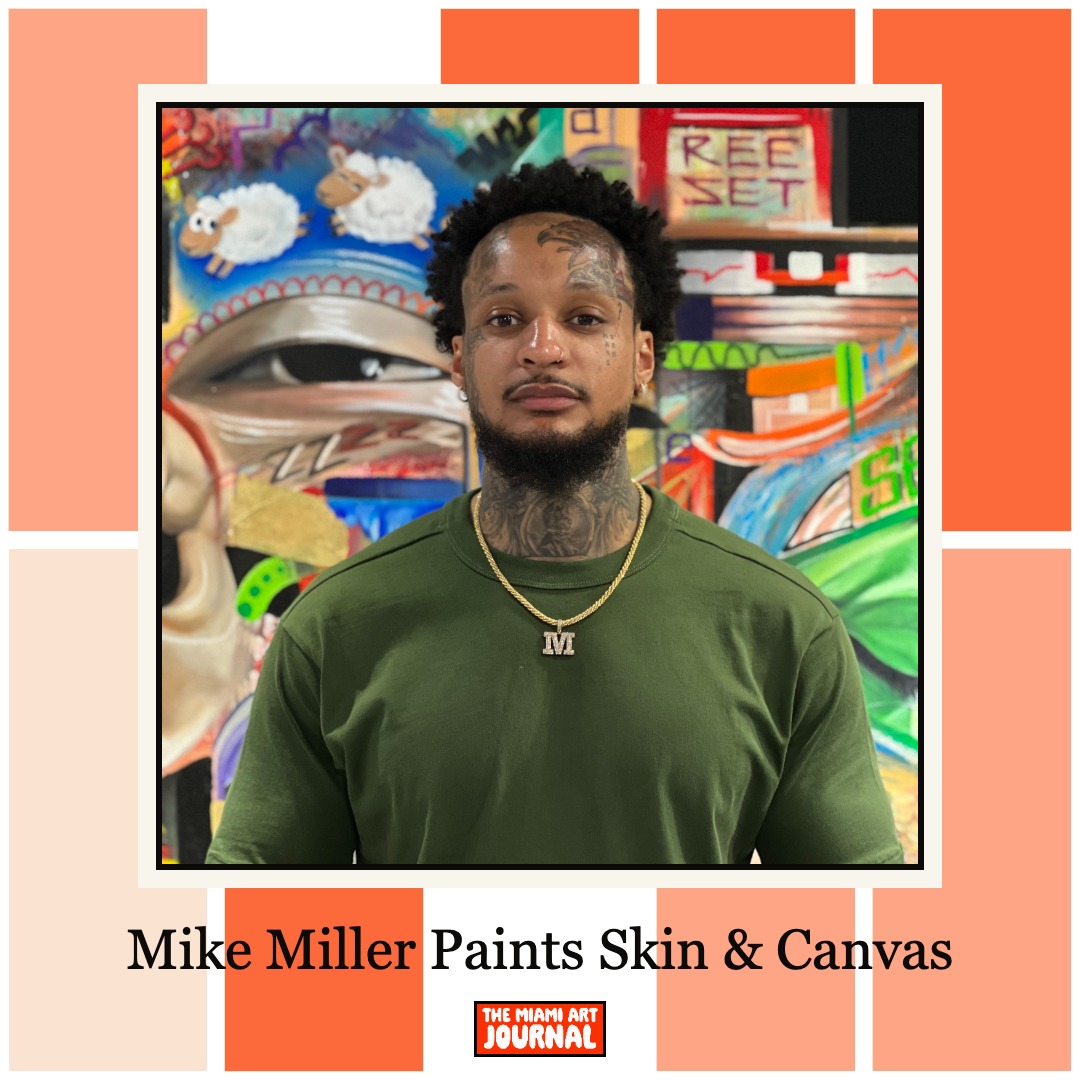
Mike Miller: Skin and Canvas
Cleveland's Art Phenom Paints With Vibrant Intensity
The Editors ·
There is a kind of artist the contemporary art world has never known quite what to do with: the one who came up through tattooing. The discipline is unforgiving in ways painting is not. A tattoo is executed once, on a living surface, with no undo. The client is awake. The skin moves. Every decision is final at the moment it is made, and the artist carries the consequence on someone else's body for the rest of that person's life. Painters, by comparison, get to be cowards. They can scrape it back, paint over it, walk away and return in a week. Mike Miller does both, and the friction between the two is the most interesting thing about his work.
Miller is a self-taught contemporary artist, born and based in Cleveland, Ohio. He is also a career tattooer and co-owner of Green Light Tattoos and Art Gallery at 1215 W 10th Street, in the East Bank of the Flats. He opened the shop with his brother Marcus and co-owner Derek Black, and it was voted Best of Cleveland in 2023 by Cleveland Magazine. The shop is Black-owned, the first of its kind downtown in the Flats, and it runs a year-long apprenticeship that handpicks artists and trains them from the ground up.
It is not incidental that every tattooer at Green Light also works in other media. The walls function as a rotating gallery of the staff's own paintings. The business model is unusual and quietly radical: a tattoo shop that refuses to treat tattooing as the ceiling of an artistic life.
Miller's painting practice began in 2012, mid-career, while he was already tattooing full time. By his own account the tattoo work is what cracked open the rest of it. A decade and change later, the paintings have become the thing he is increasingly known for.
They are dense. Layered to the point of vertigo. Miller works in mixed media specifically because it refuses to impose a limit on him, and his process is additive and subtractive at once, ideas introduced and buried and reintroduced as the surface develops. The finished pieces read as a collision between surrealism, abstraction and expressionism without settling comfortably into any of them. Figures emerge from and dissolve back into fields of saturated color. Passages that look like automatic drawing sit beside passages of tight, deliberate rendering.
The tattoo training is visible if you know where to look. There is a confidence of line running through the work that does not come from painting practice. It comes from years of making marks that cannot be taken back.
Miller's paintings have been exhibited at Truss Cleveland and at the Museum of Contemporary Art Cleveland. His work has been acquired by Intro Cleveland and by a number of professional athletes. His tattoo work has been covered by ESPN and TMZ, most prominently a three-foot back piece for an NBA guard executed across fifteen hours over three days, with the forearm left entirely to Miller's discretion.
That last detail is the tell. Given free rein on a professional athlete's shooting arm, Miller freestyled.
EditorsWhat's the thing you do in the studio that you'd be embarrassed to have filmed?
Mike MillerTalk to myself.
EditorsWhat did you get right early that you've spent years trying to get back to?
Mike MillerBeing disciplined/focused. Lately I've been feeling a bit more distracted than usual.
Discipline is the thing tattooing gives you for free. The appointment is booked, the client is in the chair, the work happens. Painting gives you none of that scaffolding. It is entirely self-imposed, and the same man who can sit fifteen hours across three days for someone else's back piece can find the studio door remarkably heavy when nobody is waiting on the other side of it. The distraction he names is not a failure of will. It is what happens when a career expands past the point where the studio is the only obligation. There is a shop now, a staff, apprentices, a gallery program.
EditorsWhere does a piece usually die? Not fail, die. What's the specific moment?
Mike MillerWhen the artist's love or interest in the piece dies.
For Miller a painting is not killed by a bad decision, a wrong color, a compositional mistake. Those are recoverable. What is not recoverable is the moment attention leaves. A painting built from countless layers requires sustained interest to survive, and interest is the one material you cannot go buy more of.
EditorsWhat's a compliment about your work that you've learned to distrust?
Mike MillerI can't say that I distrust any compliments about my work. They all seem to be quite accurate.
Most artists take the bait immediately, because the art world trains people to perform ambivalence about their own success. Miller declines. This is a man who has spent over a decade putting permanent work on other people's bodies. A certain settledness about one's own competence is not arrogance in that line of work. It is a prerequisite. Miller's position is that the work is legible. What you see is what he took, he took it openly, and there is no hidden lineage being withheld to make him look deeper.
EditorsWhat does the work cost you that people wouldn't expect? Describe the physical conditions you need to work.
Mike MillerMy health at times. Not sleeping or eating properly/enough. Typically I paint at the end of the day through the night and I prefer solitude when doing so, so it's also cost me my social life at times as well. I love it though.
Green Light opens at one in the afternoon and runs until nine. The tattooing takes the daylight hours and the social hours. Which leaves the painting to happen after nine at night, alone, on whatever is left. That is not a romantic arrangement. It is an arithmetic problem, and Miller has solved it by taking the cost out of sleep, meals and company.
EditorsWhat's in your studio that isn't a tool and isn't art?
Mike MillerEverything is art, so nothing.
Miller rejects the category itself, and the rejection is consistent with everything around him: a practice with no boundary between the work and the conditions of the work, in a shop where the walls are the gallery and the artists are the collection.
EditorsWhat would you make if you knew nobody would ever see it?
Mike MillerThere's nothing I'd make that I'd be ashamed to share with the public.
For an artist whose paintings get described as hallucinatory and mind-bending, this is a more striking claim than it first appears. The strangeness in the work is not being smuggled out under cover. It is the front door.
EditorsWhat are you not good enough at yet?
Mike MillerI'm still working on time management.
A man who co-owns a shop, tattoos full time, runs a gallery program and paints through the night is not lacking discipline. He is running four jobs out of one calendar. Which makes this the most useful thing he said: he knows exactly what stands between where the work is and where it goes next, and it is not talent, taste or nerve. It is hours.
What Comes Next
Miller describes himself as emerging, which is now closer to a formality than a description. The paintings have been in a museum. The collectors include institutions and professional athletes. The tattoo work has been on national television. The shop was voted the best in its city inside its first year.
What has not happened yet is the thing his own answers point to. A sustained body of painting made under conditions that are not the leftovers of a fourteen-hour day. The work he makes in the hours after nine at night is already exceptional. The open question is what new wonders will emerge as he dials in that ever elusive scope of time.
In Conversation
Mike Miller: Piel y lienzo
El fenómeno del arte de Cleveland pinta con intensidad vibrante
The Editors · September 15, 2026
Existe un tipo de artista que el mundo del arte contemporáneo nunca ha sabido bien qué hacer con: aquel que se formó a través del tatuaje. La disciplina es implacable de maneras que la pintura no lo es. Un tatuaje se ejecuta una sola vez, sobre una superficie viva, sin posibilidad de deshacerlo. El cliente está despierto. La piel se mueve. Cada decisión es definitiva en el momento en que se toma, y el artista lleva la consecuencia en el cuerpo de otra persona por el resto de la vida de esa persona. Los pintores, en comparación, tienen permiso para ser cobardes. Pueden raspar la capa, pintar por encima, alejarse y volver una semana después. Mike Miller hace ambas cosas, y la fricción entre ambas es lo más interesante de su obra.
Miller es un artista contemporáneo autodidacta, nacido y residente en Cleveland, Ohio. También es tatuador de carrera y copropietario de Green Light Tattoos and Art Gallery en el 1215 de la calle W 10th, en el East Bank de The Flats. Abrió el local con su hermano Marcus y el copropietario Derek Black, y fue votado como el Mejor de Cleveland en 2023 por Cleveland Magazine. El local es de propiedad negra, el primero de su tipo en el centro de The Flats, y ofrece un programa de aprendizaje de un año que selecciona a los artistas a mano y los entrena desde cero.
No es casualidad que todos los tatuadores de Green Light también trabajen en otros medios. Las paredes funcionan como una galería rotativa de las propias pinturas del personal. El modelo de negocio es inusual y silenciosamente radical: un estudio de tatuajes que se niega a tratar el tatuaje como el techo de una vida artística.
La práctica pictórica de Miller comenzó en 2012, a mitad de su carrera, cuando ya tatuaba a tiempo completo. Según su propio relato, el trabajo del tatuaje fue lo que abrió paso al resto. Una década y algo más tarde, las pinturas se han convertido en lo por lo que cada vez es más conocido.
Son densas. Capadas hasta el vértigo. Miller trabaja en mixed media específicamente porque se niega a imponerle un límite, y su proceso es aditivo y sustractivo a la vez, ideas que se introducen, se entierran y se reintroducen a medida que la superficie se desarrolla. Las piezas terminadas se leen como una colisión entre el surrealismo, la abstracción y el expresionismo sin asentarse cómodamente en ninguna de ellas. Las figuras emergen de y se disuelven de nuevo en campos de color saturado. Pasajes que parecen dibujo automático se sitúan junto a pasajes de un trazo ajustado y deliberado.
La formación en tatuaje es visible si sabes dónde mirar. Hay una confianza en la línea que recorre la obra y que no proviene de la práctica pictórica. Proviene de años haciendo marcas que no se pueden deshacer.
Las pinturas de Miller se han expuesto en Truss Cleveland y en el Museum of Contemporary Art Cleveland. Su obra ha sido adquirida por Intro Cleveland y por varios atletas profesionales. Su trabajo en tatuajes ha sido cubierto por ESPN y TMZ, destacando especialmente una pieza de tres pies en la espalda de un base de la NBA, ejecutada en quince horas repartidas en tres días, dejando el antebrazo completamente a discreción de Miller.
Ese último detalle es la clave. Con libertad total en el brazo de tiro de un atleta profesional, Miller improvisó.
Editores: ¿Qué es lo que haces en el estudio de lo que te daría vergüenza que te grabaran?
Mike MillerHablar conmigo mismo.
Editores: ¿Qué es lo que acertaste al principio y en lo que has pasado años intentando volver?
Mike MillerSer disciplinado/focado. Últimamente me siento un poco más distraído de lo habitual.
La disciplina es lo que el tatuaje te da gratis. La cita está reservada, el cliente está en la silla, el trabajo ocurre. La pintura no te da ninguno de esos andamios. Es enteramente autoimpuesta, y el mismo hombre que puede sentarse quince horas repartidas en tres días para la espalda de otra persona puede encontrar la puerta del estudio notablemente pesada cuando nadie espera al otro lado. La distracción que nombra no es un fallo de voluntad. Es lo que ocurre cuando una carrera se expande más allá del punto en que el estudio es la única obligación. Ahora hay un local, un equipo, aprendices, un programa de galería.
Editores: ¿Dónde muere normalmente una pieza? No falla, muere. ¿Cuál es el momento específico?
Mike MillerCuando el amor o el interés del artista por la pieza mueren.
Para Miller una pintura no se mata por una mala decisión, un color equivocado, un error compositivo. Esos son recuperables. Lo que no es recuperable es el momento en que la atención se marcha. Una pintura construida a partir de innumerables capas requiere un interés sostenido para sobrevivir, y el interés es el único material del que no puedes comprar más.
Editores: ¿Qué cumplido sobre tu obra has aprendido a desconfiar?
Mike MillerNo puedo decir que desconfíe de ningún cumplido sobre mi obra. Todos parecen bastante acertados.
La mayoría de los artistas muerden el anzuelo inmediatamente, porque el mundo del arte entrena a la gente para interpretar la ambivalencia sobre su propio éxito. Miller declina. Este es un hombre que ha pasado más de una década haciendo trabajo permanente en el cuerpo de otras personas. Una cierta tranquilidad sobre su propia competencia no es arrogancia en ese oficio. Es un prerrequisito. La posición de Miller es que la obra es legible. Lo que ves es lo que tomó, lo tomó abiertamente, y no hay una linaje oculto que se esté reteniendo para hacerlo parecer más profundo.
Editores: ¿Qué te cuesta el trabajo que la gente no esperaría? Describe las condiciones físicas que necesitas para trabajar.
Mike MillerMi salud a veces. No dormir o comer adecuadamente/suficiente. Típicamente pinto al final del día durante toda la noche y prefiero la soledad al hacerlo, así que también me ha costado mi vida social a veces.
Green Light abre a la una de la tarde y cierra a las nueve. El tatuaje ocupa las horas de luz y las horas sociales. Lo que deja la pintura para que ocurra después de las nueve de la noche, solo, con lo que queda. Esa no es una disposición romántica. Es un problema aritmético, y Miller lo ha resuelto pagando el coste con sueño, comidas y compañía.
Editores: ¿Qué hay en tu estudio que no es una herramienta y no es arte?
Mike MillerTodo es arte, así que nada.
Miller rechaza la categoría misma, y el rechazo es coherente con todo lo que le rodea: una práctica sin frontera entre la obra y las condiciones de la obra, en un local donde las paredes son la galería y los artistas son la colección.
Editores: ¿Qué harías si supieras que nadie lo vería nunca?
Mike MillerNo hay nada que haría de lo que me diera vergüenza compartir con el público.
Para un artista cuyas pinturas se describen como alucinógenas y perturbadoras, esta es una afirmación más impactante de lo que parece a primera vista. La extrañeza en la obra no se está introduciendo furtivamente bajo cobertura. Es la puerta principal.
Editores: ¿En qué aún no eres lo suficientemente bueno?
Mike MillerTodavía estoy trabajando en la gestión del tiempo.
Un hombre que es copropietario de un local, tatúa a tiempo completo, dirige un programa de galería y pinta durante la noche no carece de disciplina. Está gestionando cuatro trabajos en un solo calendario. Lo que hace que esto sea lo más útil de lo que dijo: sabe exactamente qué hay entre donde está el trabajo y hacia dónde va a continuación, y no es el talento, el gusto o el valor. Son las horas.
Qué sigue
Miller se describe a sí mismo como emergente, lo cual ahora es más una formalidad que una descripción. Las pinturas han estado en un museo. Los coleccionistas incluyen instituciones y atletas profesionales. El trabajo de tatuaje ha estado en la televisión nacional. El local fue votado como el mejor de su ciudad en su primer año.
Lo que aún no ha ocurrido es lo que sus propias respuestas apuntan. Un cuerpo sostenido de pintura hecho en condiciones que no son los restos de un día de catorce horas. El trabajo que hace en las horas posteriores a las nueve de la noche ya es excepcional. La pregunta abierta es qué nuevas maravillas emergerán a medida que ajuste ese alcance del tiempo tan esquivo.
Edición en español traducida por Mars, el sistema de la casa. Revisión del editor: pendiente.