La edición en español de esta pieza está en preparación.
Miami's source for art, luxury living & technologyEst. 2026
Sponsored
The House
Who Has Them Tonight
FamCheck: a shared calendar built for the handover, not the argument
The Editors ·
A Miami household rarely runs on one adult. A housekeeper three mornings a week, a grandmother on Sundays, a sitter on Thursday, a co-parent every other weekend, a night nurse for a parent upstairs. The architecture of care in a large home is a rotation, and the dangerous moment in any rotation is not the work. It is the handover.
AARP and the National Alliance for Caregiving found this year that 63 million American adults now provide unpaid care, and that 53 percent of them have unpaid help from somebody else. Half of American caregiving is already a rotation. The same report found that technology for watching someone remotely, cameras and wearables and check-in apps, nearly doubled in five years. Technology for coordinating between the humans moved from 17 percent to 19.
We have built a great deal of surveillance for the home and almost nothing for the shift change.
What it is
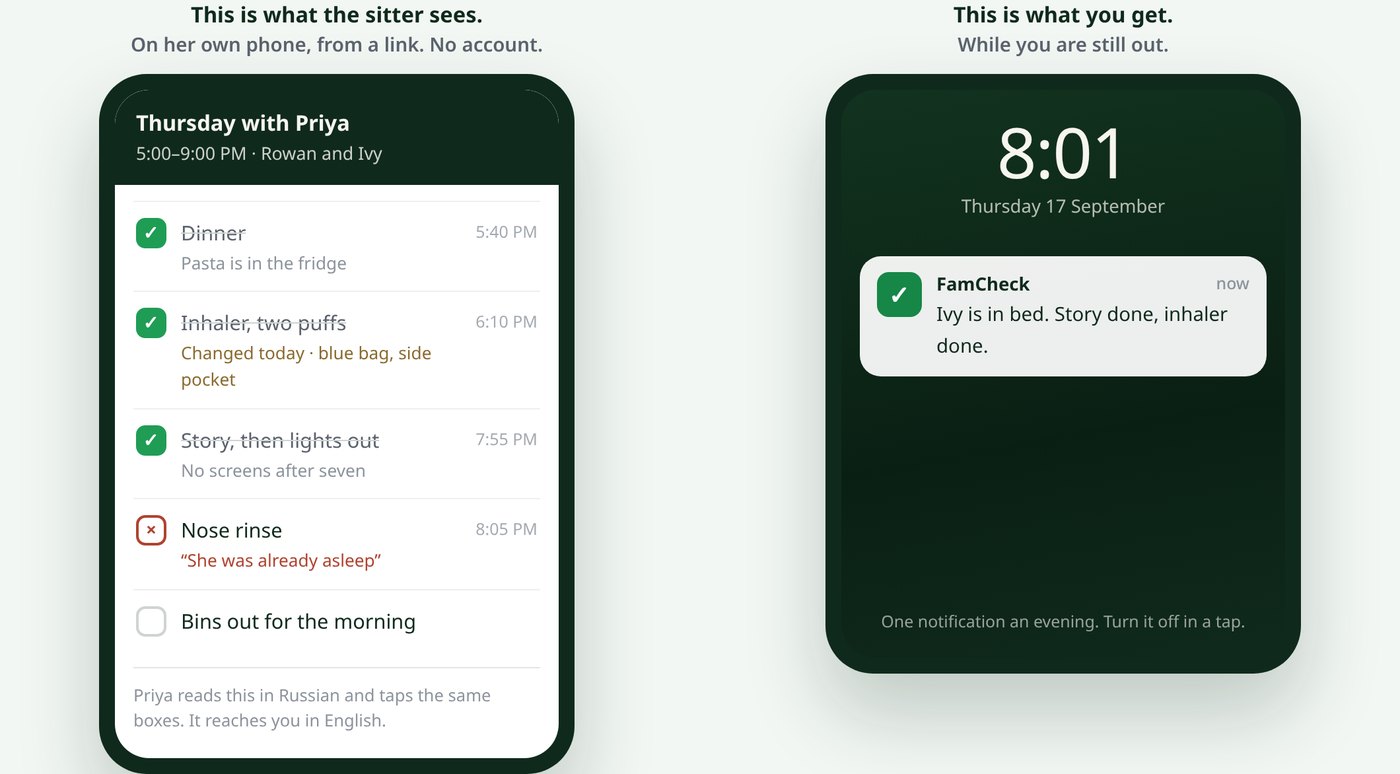
FamCheck is a shared calendar for households where more than one adult looks after someone. A parent or a principal writes the routine down once: bedtime, the medicine and its exact hour, the allergy, the emergency contact, the thing that always gets forgotten. That record is then handed to whoever is on duty through a single link.
The link is the whole design. The person receiving it makes no account, installs no application, and sets no password. A grandmother, a sitter, a new housekeeper opens a web page and sees this evening, in order, with the medicine at the top.
The part that matters in a multilingual city
The handover reads in six languages: English, Spanish, Haitian Creole, Portuguese, Mandarin and Russian. In a city where the person holding a child's inhaler at seven in the evening may not read English, that is not a feature list item. It is the difference between a schedule and an instruction that can be followed.
What it costs, and what it does not do
Pricing is a flat 9.99 dollars a month for an entire household rather than per adult, which is the pricing model most of this category uses. Two of its tools are free permanently with no sign-up at all.
It is also worth saying what it is not. It is a web service, not a native app, so there is no icon on a home screen. It is new, and it does not carry the two decades of court familiarity that the established custody platforms trade on, though it does export a signed record that a third party can verify independently.
The useful thing
Whether or not you use any product for it, write the handover down once, in a form the next adult can read without you in the room, and put the four things that actually cause incidents at the top: the medication and its time, the allergy, who to call, and the thing that always gets forgotten.
Then check the one gate almost nobody checks. For school or daycare collection, absent a court order on file, a custodial and a non-custodial parent generally have equal right to collect a child, and any third party needs written authorisation plus photo identification for staff who do not know them. A same-day substitute only works if that person is already on the authorised list, or the school will accept written permission before dismissal. Arranging that at four on a Thursday afternoon is not a plan.
Medicine wrote this lesson down a long time ago. In May 2007 the World Health Organization published its nine patient safety solutions, and the third is not about surgery or medication. It is communication during patient hand-overs. Standardise the format. Leave time for questions. Read it back.
A house with staff and a house with a grandmother have the same structure. Neither has the protocol.
FamCheck: un calendario compartido diseñado para la entrega de turnos, no para los argumentos
The Editors · September 17, 2026
Un hogar en Miami rara vez funciona con un solo adulto. Una empleada del hogar tres mañanas a la semana, una abuela los domingos, una niñera los jueves, un coparente cada fin de semana alterno, una enfermera nocturna para un padre en el piso de arriba. La arquitectura del cuidado en una casa grande es una rotación, y el momento peligroso en cualquier rotación no es el trabajo. Es la entrega.
La AARP y la Alianza Nacional para el Cuidado encontraron este año que 63 millones de adultos estadounidenses ahora brindan cuidado no remunerado, y que el 53 por ciento de ellos recibe ayuda no remunerada de otra persona. La mitad del cuidado en Estados Unidos ya es una rotación. El mismo informe encontró que la tecnología para vigilar a alguien de forma remota, cámaras, dispositivos portátiles y aplicaciones de verificación, casi se duplicó en cinco años. La tecnología para coordinar entre los humanos pasó del 17 por ciento al 19 por ciento.
Hemos construido una gran cantidad de vigilancia para el hogar y casi nada para el cambio de turno.
Qué es
FamCheck es un calendario compartido para hogares donde más de un adulto cuida de alguien. Un padre o un director escribe la rutina una vez: la hora de dormir, el medicamento y su hora exacta, la alergia, el contacto de emergencia, lo que siempre se olvida. Ese registro se entrega luego a quien esté de turno a través de un solo enlace.
El enlace es todo el diseño. La persona que lo recibe no crea una cuenta, no instala ninguna aplicación y no establece ninguna contraseña. Una abuela, una niñera, una nueva empleada del hogar abre una página web y ve esta noche, en orden, con el medicamento en la parte superior.
La parte que importa en una ciudad multilingüe
La entrega se lee en seis idiomas: inglés, español, criollo haitiano, portugués, mandarín y ruso. En una ciudad donde la persona que sostiene el inhalador de un niño a las siete de la noche puede que no lea inglés, eso no es un elemento de una lista de características. Es la diferencia entre un horario y una instrucción que se puede seguir.
El costo y lo que no hace
El precio es una tarifa plana de 9,99 dólares al mes para todo un hogar, en lugar de por adulto, que es el modelo de precios que usa la mayoría de esta categoría. Dos de sus herramientas son gratuitas permanentemente sin necesidad de registrarse en absoluto.
También vale la pena decir lo que no es. Es un servicio web, no una aplicación nativa, por lo que no hay un icono en la pantalla de inicio. Es nuevo y no cuenta con las dos décadas de familiaridad judicial de las plataformas de custodia establecidas, aunque exporta un registro firmado que una tercera parte puede verificar de forma independiente.
Lo útil
Ya sea que uses o no cualquier producto para ello, escribe la entrega una vez, en un formato que el siguiente adulto pueda leer sin ti en la habitación, y pon las cuatro cosas que realmente causan incidentes en la parte superior: el medicamento y su hora, la alergia, a quién llamar y lo que siempre se olvida.
Luego verifica la única puerta que casi nadie verifica. Para la recogida en la escuela o el centro de día, a falta de una orden judicial en el expediente, un padre custodio y un padre no custodio generalmente tienen el mismo derecho a recoger a un niño, y cualquier tercera parte necesita autorización por escrito más identificación con foto para el personal que no los conoce. Un sustituto del mismo día solo funciona si esa persona ya está en la lista autorizada, o la escuela aceptará un permiso por escrito antes de la salida. Organizar eso a las cuatro de la tarde del jueves no es un plan.
La medicina escribió esta lección hace mucho tiempo. En mayo de 2007, la Organización Mundial de la Salud publicó sus nueve soluciones de seguridad del paciente, y la tercera no trata sobre cirugía o medicación. Es la comunicación durante la entrega de pacientes. Estandariza el formato. Deja tiempo para preguntas. Léelo de nuevo.
Una casa con personal y una casa con una abuela tienen la misma estructura. Ninguna tiene el protocolo.